









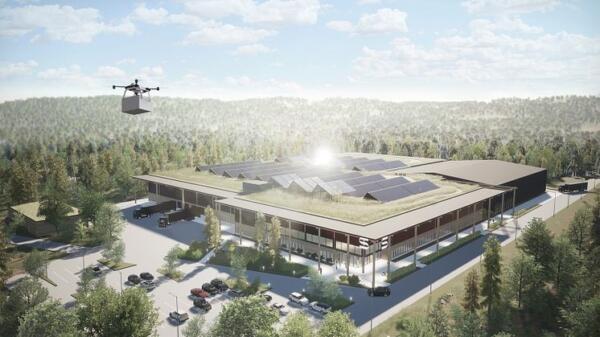
PaperShell, the Swedish material company behind a new fossil-free composite material designed to replace aluminium, plastics and glass fibre at industrial scale, has signed a Grant Agreement with the European Commission under the EU Innovation Fund. The agreement secures up to €40.3 million in financing to expand industrial production through a new flagship factory in Tibro, Sweden. The flagship represents the first full-scale implementation of a production system designed to be replicated across Europe and beyond.
PaperShell’s new material is 100% fossil-free and combines strength, cost efficiency, lower weight and higher flexibility compared to conventional alternatives such as plastics, aluminium and glass fibre. The material is NATO approved and is already being used across sectors including construction, electronics, defence and transport. PaperShell’s existing pilot factory in Tibro, in operation since [2023], has three production lines and has produced more than 150,000 components to date. [The company is cash flow positive since Q4 2025].
Anders Breitholtz, Founder and CEO of PaperShell, comments: “Europe is entering a new industrial phase where resilience and decarbonisation go hand in hand. PaperShell is already producing fossil-free materials at industrial scale, and with this expansion we can meet growing demand from sectors like construction and defence. The factory in Tibro is not just increased capacity — it is proof that a new industrial production system is ready to scale.”
Construction is expected to start in [2027], with entry into full operation in 2030. At full ramp-up, the facility is expected to reach an installed production capacity of approximately 23,000 tonnes per year. Over its first ten years of operation, the project is expected to avoid approximately 2.6 million tonnes of CO₂ emissions.
The project shows how science, industrial production and capital can come together to build a new generation of European industry based on fossil-free materials, strengthening industrial resilience, accelerating reindustrialisation and reducing greenhouse-gas emissions.